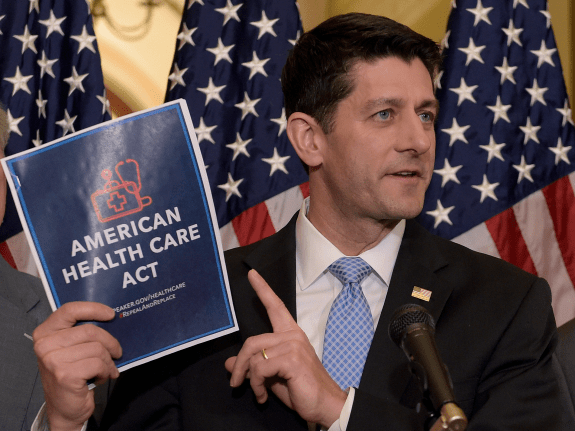
House Speaker Paul Ryan during a news conference Tuesday about the American Health Care Act on Capitol Hill
On FOX News Sunday, Paul Ryan said House GOP members are working to improve the American Health Care Act ahead of an expected vote on the measure on Thursday, March 23, the seventh anniversary of former President Obama signing the Affordable Care Act into law. The GOP Healthcare bill does not do enough to protect seniors and low-income Americans from rising health-care costs.
As the Agency for Health Care Administration(AHCA) stands, it seems that some seniors could be left without adequate care, because the bill’s tax-credit structure won’t provide as much coverage as the Affordable Care Act’s (ACA) subsidies currently do. As a result of the ACA, restricted insurers’ ability to “age-rate” or charge much higher premiums for older individuals, repealing the bill will cause an initial increase in premiums for low-income seniors not yet on Medicare.
The changes that House GOP members are working on this week are expected to address these concerns by providing more generous tax credits for older, low-income Americans, so that they won’t lose care once the Obamacare subsidies are repealed.
There are 40 GOP representatives who will not vote for the bill in its current form. In order for it to pass the House, there can be no more than 21 Republican “no” votes. There are several GOP senators opposed to the bill, some of whom want a clean repeal of Obamacare, and other more moderate Republicans who fear that the repeal could hurt low-income Americans according to CNN.
To appease conservative lawmakers, House Speaker Paul Ryan and Republican leadership are looking at giving states the option of requiring able-bodied Medicaid recipients to work, a provision Republicans have long wanted. Right-leaning members have been especially irked since Obamacare expanded Medicaid to 11 million able-bodied adults without children.
The Trump administration is already moving in this direction through the Medicaid waiver system. Health & Human Services Secretary Tom Price and Seema Verma, the administrator of the Centers for Medicare and Medicaid Services, sent a letter to governors Tuesday saying they are open to allowing states to add work requirements for Medicaid recipients — as well as premiums and co-pays. Granting such waiver requests from the states would be a major departure from how the Obama administration oversaw Medicaid. It rejected attempts by states to add a work mandate.
The legislation would give states the option to receive federal Medicaid funding as a block grant. The current legislation calls for giving states a set amount of money per enrollee, known as a per capita cap system. Both would be a major change from the current way Medicaid is funded, which is open-ended federal support tied to state spending on the program.
Under a block grant, states would receive a fixed amount of federal funding each year, regardless of how many participants are in the program. This would reduce federal support for Medicaid even more since the funding level would not adjust for increases in enrollment, which often happens in bad economic times.
 Leondra Head